
The Ultimate Guide to Nonprofit Operations Management
On any given day, your nonprofit’s staff and volunteers are busy conducting outreach, delivering critical programming, planning fundraisers, and reaching out to donors. With so much to do and limited resources to work with, figuring out how to manage the day-to-day mechanics of your organization can feel like an impossible balancing act.
Too often, nonprofit leaders are told to "run more like a business”—but that advice ignores the unique realities, capacities, and cultures of the mission-driven sector. Ultimately, nonprofits rely on real people for operational success. When those people have the right tools and capacity management, your organization thrives. When they don’t, you get burnout, data silos, and stalled growth.
In this guide, we will walk through everything you need to know to build sustainable, scalable systems that actually fit your current stage of growth, including:
Whether you are a new nonprofit operating out of shared spreadsheets or a mature institution looking to improve your approach, we will cover the foundational concepts and best practices to help you stop fighting your data and start scaling your impact.
Nonprofit Operations: FAQs
What are nonprofit operations?
Nonprofit operations refer to the essential, day-to-day activities and functions required to keep the organization running and fulfill its mission. We split our operating systems into four categories (with the caveat that these are the best-fit buckets; some tasks could fit into multiple buckets).
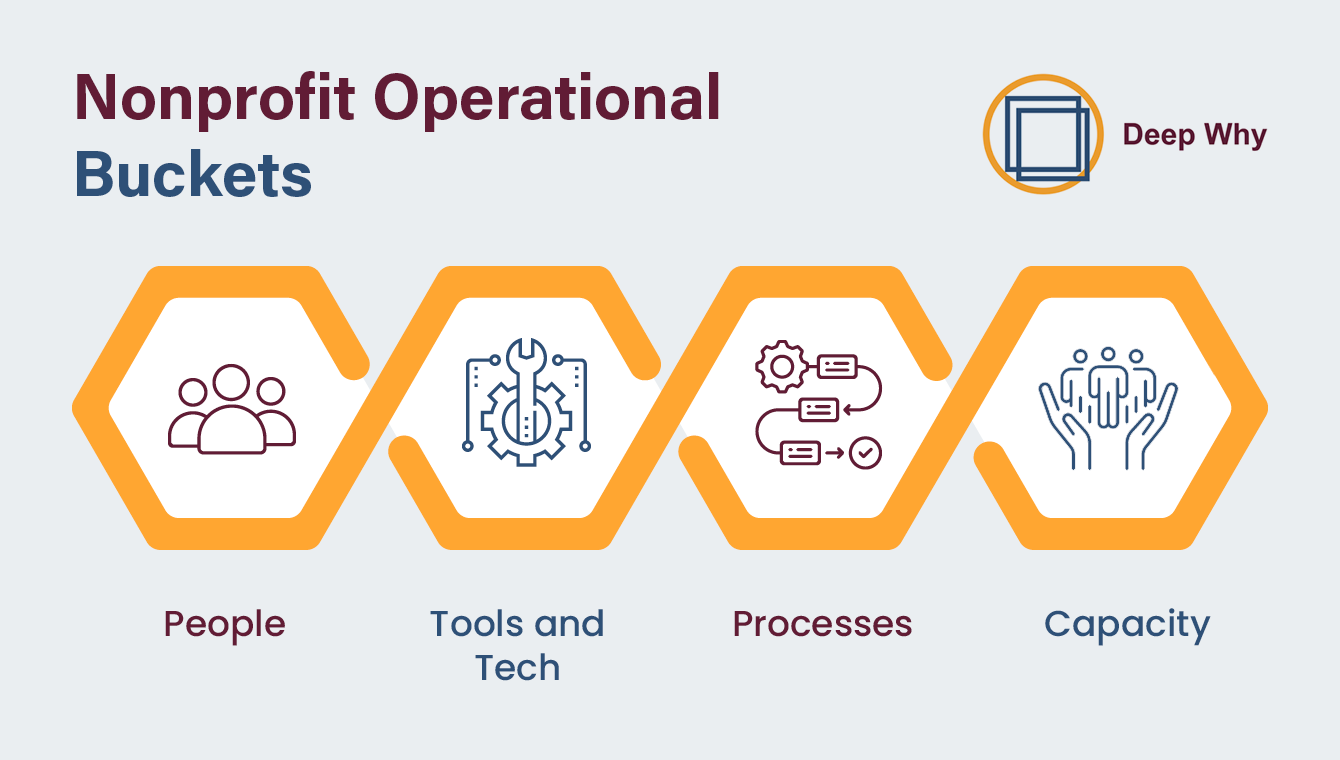
People
This bucket contains anything directly related to recruiting, managing, and interacting with your community members.
Human Resources (HR): Staff and volunteer recruitment, training, management, benefits administration, policy development
Marketing and communications: Public relations, brand management, website maintenance, outreach to stakeholders
Tools and Technology
This bucket contains the physical, digital, and structural items your people use to execute their tasks.
Information Technology (IT): Managing hardware, securing data
Facilities and asset management: Maintaining tangible resources like physical offices and equipment
Processes
This bucket contains the actions, workflows, and rules that ensure your team does its work consistently and legally.
Program delivery: The core activities directly related to the mission (planning, implementation, evaluation, quality control of services)
Governance and compliance: Board management, legal filings, regulatory compliance (e.g., IRS 990), adherence to ethical standards
Capacity
This bucket contains the functions that directly dictate or measure the work the organization can realistically take on.
Financial management: Budgeting, accounting, payroll, financial reporting, auditing, and managing cash flow
Fundraising and development: Grant writing, donor management, organizing campaigns and events, cultivating major gifts
Put simply, operations is the process of turning your inputs into outputs that, when combined, make up your programs and services. When an operating system is healthy and aligned, the daily work happens friction-free.
How do nonprofits operate compared to for-profit organizations?
Understanding how nonprofits and corporations differ operationally requires examining their inputs and outputs. A corporate entity takes raw materials and financial capital to produce a profitable margin. Their operational goal is usually to make the assembly line cheaper and faster.
A nonprofit, however, operates with a blend of multiple stakeholders (donors, volunteers, boards, and program participants) and high accountability. For most nonprofits, the "raw materials" are your staff’s energy and your community’s support. The "outputs" are the services that best support the organization’s strategy. So, by design, you need to make your operations human-centered and flexible, given tight capacity restraints.
Why is nonprofit operations management important?
Efficient nonprofit operations management does more than keep the lights on—it prevents staff burnout, ensures you have accurate data, and enables your organization to work cohesively towards your goals.
For example, poorly managed operations cause program staff to work inefficiently and run into avoidable headaches. Effective operational management, however, ensures that all team members are aligned, have equal access to centralized systems, and understand their specific contributions to the nonprofit's growth. For instance, here’s how a development team might access the data for an upcoming sponsorship pitch call in an efficient vs. inefficient setting:
Poor operational workflow: The development team spends several hours tracking down the correct donor contact information, sifting through outdated spreadsheets and other systems, only to discover that the most recent impact data is on a restricted shared drive that requires a special access request.
Great operational workflow: A development team member logs into the central constituent relationship management (CRM) system, filters for the specific prospect, and finds all current contact details, giving levels, and a linked, automatically updated report on recent program impact—all within ten minutes.
Who is involved in managing nonprofit operations?
Managing operations requires all hands on deck. Here’s how the duties usually break down for nonprofits:
The board of directors focuses on governance, oversight, and strategy-level guidance. They ensure the organization is moving in the right direction long-term.
Executive leadership runs the day-to-day execution, translating the board's strategy into actionable plans, managing resources, and ensuring accountability across all departments. They focus on driving operational efficiency and achieving the board’s strategic goals.
Staff members execute the core programs and services, interacting directly with beneficiaries and stakeholders. Their impact is in delivering the organization's mission and producing measurable outcomes.
Volunteers provide essential support by dedicating their time and skills to supplement staff efforts, often directly assisting with program delivery, fundraising, or administrative tasks. They extend the organization's reach and capacity with minimal financial investment required.
Every nonprofit has different strategic goals, which means these responsibilities might change. Regardless of your specific breakdown of roles, ensure everyone does their part for the nonprofit by understanding how they contribute to operations (more on that later).
How to Improve Your Nonprofit Operations
Nonprofits can innovate their operations at any point in their evolution. We’ve broken down tactics based on where the nonprofit is in its lifecycle:
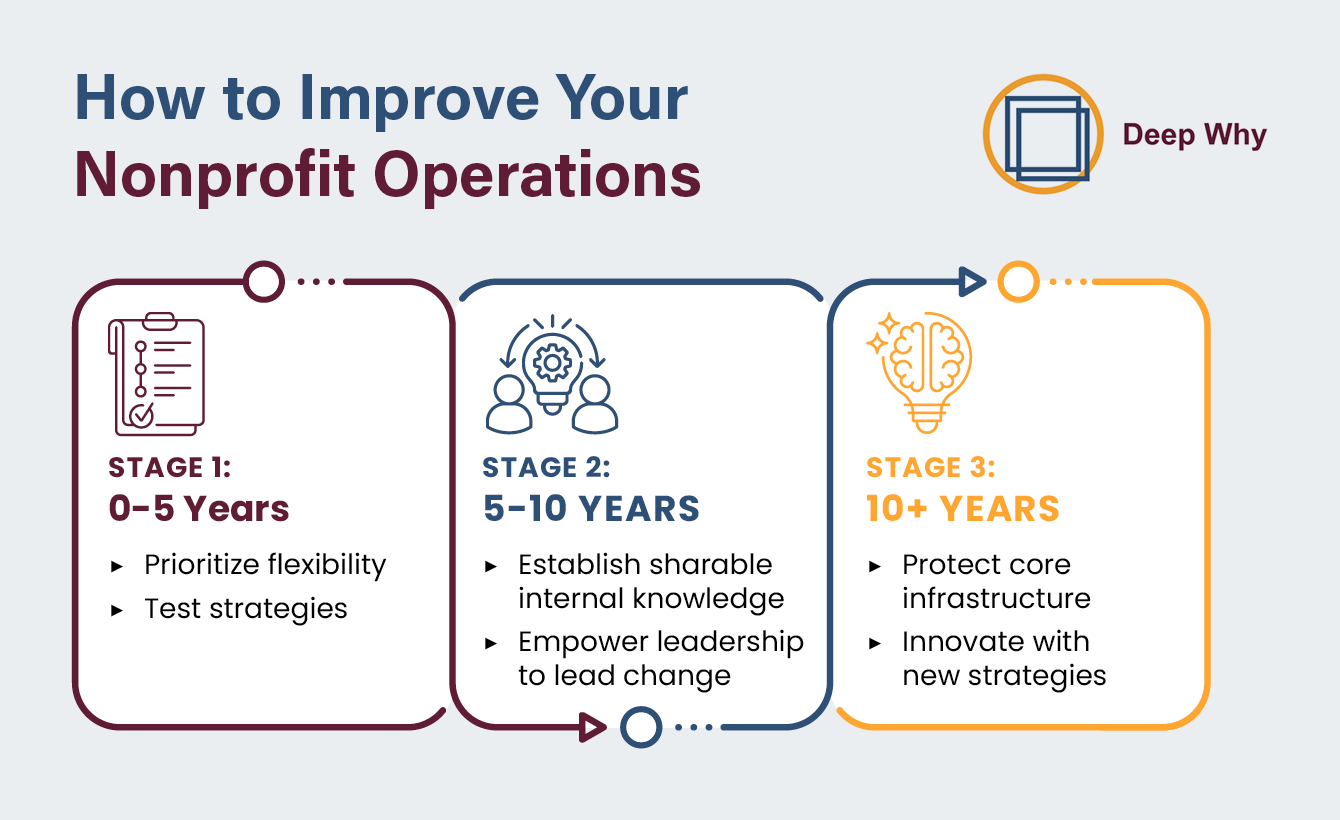
Stage 1: Early Stage/Start-Ups (0-5 Years)
Early-stage organizations are characterized by high energy, adaptability, and determination. At this stage, you are highly reliant on the knowledge and expertise of individual founders or key staff members and are focusing on building a loyal support base.
The largest challenge many new nonprofit organizations face is a lack of direction. You might frequently change your mind about your strategy and the specific services you provide because you are still actively learning what works for your community.
During this stage, prioritize flexibility. Do not lock yourself into rigid processes or buy massive enterprise software systems just yet. Because you cannot achieve efficiency until you can commit to consistency, your energy is best spent using highly agile, low-investment tools like shared documents and spreadsheets. Spend this time testing strategies, gathering feedback, and defining your core values without getting bogged down by restrictive tech.
Stage 2: Maturing/Scaling Up (5-10 Years)
Organizations usually enter the maturing phase when they have successfully proven their model and invested in tech tools, which makes service demand outpace their manual capacity. With a higher volume of services comes an influx of potential bottlenecks—and your founder can’t be the sole decision maker anymore.
At this point, you must establish sharable internal knowledge and empower your staff to take on more operational duties. That way, your staff can make decisions autonomously and boost your capacity with fewer slowdowns along the way.
Keep in mind that documenting everything and creating new rules can alienate employees who are used to less structure. A successful strategy in this phase requires strong leadership that can manage this transition, explaining that new systems aren't there to restrict staff, but to ensure the organization's long-term survival.
Stage 3: Mature and Institutional Organizations (10+ Years)
Mature organizations have fully committed to a strategy. Their processes are well-documented, roles are highly specialized, and decision volatility is very low. At this point, your nonprofit will know exactly who it serves, what it does, and how to measure success.
The biggest threat to a mature organization isn't chaos; it is complacency. Refusing to evolve your processes can hold your organization back from capitalizing on new opportunities.
That’s why your strategic focus must be on protecting your core infrastructure while still making room for careful innovation. Because a mature operating system is highly interconnected, you must manage changes slowly and deliberately to avoid downstream disasters. Many mature organizations create designated pilot projects to test new ideas safely without disrupting the entire system.
Best Practices for Managing Nonprofit Operations
Once you’ve aligned your strategy with your lifecycle stage, daily execution comes down to managing friction points. These tactical best practices are designed to help you streamline workflows, implement technology thoughtfully, and center the humans doing the actual work.
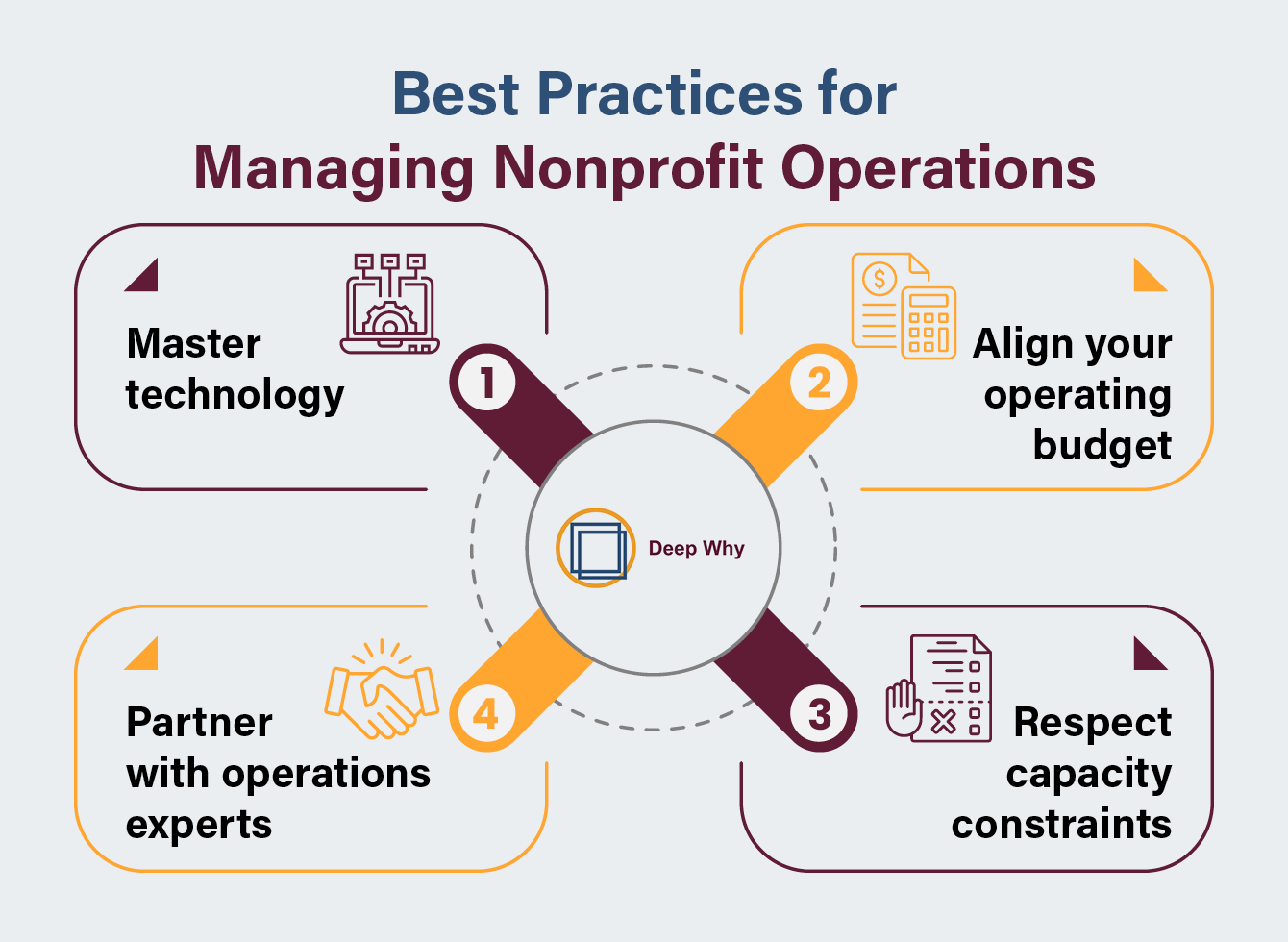
1. Master technology and data management
The infrastructure that powers your operations is your tech stack. Implementing new systems won’t fix broken operations; it will simply automate your current inefficiencies. Before investing in a powerful platform like Salesforce, you must first do the operational legwork by:
Identifying pain points and inefficiencies
Defining clear goals for the project
Determining data requirements and key performance indicators (KPIs)
Cleaning your existing data
Developing a phased implementation plan
When your tools and data management tactics are aligned with clearly defined processes, your CRM becomes a true operational asset, creating a single source of truth that stops your team from fighting their systems and empowers them to make strategic decisions.
2. Align your nonprofit operating budget for capacity
To support your mission effectively, you need to align your nonprofit's operating budget with your strategic intent. This means shifting your perspective from seeing operations as just overhead to treating them as essential capacity building. To properly align your budget for operational capacity, you should:
Acknowledge the upfront investment. Address the misconception that improving operations will immediately save you money. Every move toward scale or efficiency requires a substantial initial investment of time, energy, and capital to enact the change.
Fund ongoing maintenance. Don’t just budget for the launch of a new system; budget for its long-term survival. Remember the ongoing financial resources required to maintain efficiency, such as software licenses and consultant support.
Invest in operational talent. Whether it means building an internal operations team, funding ongoing staff training, or hiring consultants to untangle your database, funding the people who manage your operations is essential to secure your investment.
While your budget should be sustainable, make sure it can be changed if needed. Operations requirements can change daily, so build in the flexibility to move resources around if needed.
3. Respect your capacity constraints
Your organization's real-world constraints define its capacity—so you can’t design an operating system that requires your team to run at 110% all of the time. When designing or fixing a workflow, actively protect your team's bandwidth by:
Building in processes that function smoothly when staff are operating at a normal, healthy pace. If your service delivery relies on constant overtime, it’s time to change your expectations and switch to a more resilient workflow.
Auditing your workflows for administrative bloat. Are your workers spending time on tasks that actually add value? Cut the busywork that drains capacity without significant benefits.
Prioritizing the staff experience. Treat your employees' time and emotional energy as valuable operational assets. When you streamline their daily tasks and remove frustrating technological roadblocks, you directly protect them from burnout and keep them focused on the mission.
4. Partner with an operations expert
It can be challenging to get an actionable view of your operations from the inside. Engaging an external operations consultancy provides the technical expertise and perspective required to untangle complex workflows without disrupting your daily service delivery. Bringing in an external operations expert allows you to:
Gain a neutral facilitator for process design. Documenting processes often sparks cultural friction between staff who value flexibility and management seeking consistency. An outside expert acts as a neutral third party to mediate these discussions and provide honest recommendations.
Focus on your mission. Your frontline staff should be spending their time on mission-critical activities, not trying to figure out tech solutions that are outside their role. A partner absorbs the technical burden, protecting your team's capacity and preventing burnout.
Prevent expensive software missteps. A CRM or other software solution is a big investment that you want to get right. Before deciding on a tool, an operations partner helps you critically assess your needs and tech stack to find the best solution, ensuring you don't waste budget on the wrong software.
Looking for an operations partner? Deep Why Design takes a human-centric approach to ensure your technology matches your mission and your team. Our technology and operations specialists collaborate with you to map your processes, build high-quality data management systems, and enhance your approach to operations.
Wrapping Up
Tackling your operational issues head-on can be overwhelming. Start small by surveying your team about operational gaps that should be filled. Also, look at your CRM data to find any discrepancies or opportunities for improvement. As long as you innovate with your people, tools, processes, and capacity in mind, you can operate on a different level and take your mission to new heights.
Demystifying Salesforce for Nonprofits: A Crash Course Guide. Salesforce is a powerful CRM that nonprofits use to streamline operations. Learn more in our guide.
Nonprofit Data Analytics: Overview & How to Get Started. Data is the foundation of any robust operational strategy. Brush up on your skills in this guide.
Nonprofit Data Sharing: What Your Nonprofit Needs to Know. Being able to share information seamlessly across your nonprofit is critical for operational success. This guide has you covered with the fundamentals of data sharing.

About the Author: Jenn Taylor
Jenn Taylor has worked directly with more than 100 nonprofits and educational organizations to help them implement new or transform existing digital systems, adjust processes accordingly, and problem-solve throughout implementation to ensure successful adoption. Through this work she has become dedicated to correcting the sector-wide inefficiencies that are a drain on nonprofit time and resources. Her current focus is humanizing digital systems in the social sector by making them transparent, equitable, effective, and trusted.